

 English
  中文简体
中文简体 


Content
- Why American Power Strips Don't Work Directly in Europe
- US vs. European Electrical Standards: Side-by-Side Comparison
- Can You Ever Use an American Power Strip in Europe? The Exception
- The Right Solution: What to Use Instead
- Comparing Your Options for Using Power Strips in Europe
- European Plug Types by Country: What Adapter Do You Need?
- What Devices Are Safe to Use in Europe Without a Converter?
- Safety Risks of Using the Wrong Power Equipment
- Practical Tips for Charging Multiple Devices in Europe
- Frequently Asked Questions (FAQ)
- Can I use a US power strip in Europe with just a plug adapter?
- What happens if I plug a 120V power strip into a 240V European outlet?
- Do I need a voltage converter or just a plug adapter for my laptop in Europe?
- Is the UK the same as the rest of Europe for plugs and voltage?
- Can I use a European power strip in the United States?
- What is the best power strip to bring to Europe from the US?
- How many watts can a European outlet supply?
- Are surge protectors necessary in Europe?
- Conclusion
Why American Power Strips Don't Work Directly in Europe
The biggest obstacle is the voltage difference, not just the plug shape. Many travelers mistakenly think that using a simple plug adapter — the kind that just changes the physical shape of the prongs — is enough to make a US power strip work in Europe. It is not. A plug adapter only solves the mechanical connection; it does nothing to change the 240V electricity coming out of the European socket.
The Voltage Problem: 120V vs. 240V
European outlets deliver twice the voltage of American ones, which is more than enough to destroy or ignite most US power strips. Standard US power strips are rated for 120V. When 240V flows through a 120V-rated device, the internal components — wiring insulation, surge protection circuitry, and MOVs (metal-oxide varistors) — are immediately overwhelmed. You might see sparks, smell burning plastic, or worse, trigger a fire.
The Frequency Problem: 60Hz vs. 50Hz
Even if voltage were corrected, the 50Hz frequency in Europe (vs. 60Hz in the US) can cause certain devices to run slower, overheat, or malfunction. This is especially relevant for devices with motors (fans, older chargers) and certain electronic components. Most modern electronics with switching power supplies handle both 50Hz and 60Hz, but older or cheaper devices may not.
The Plug Shape Problem
American plugs (Type A — two flat parallel prongs) are physically incompatible with European sockets, which use Type C, E, F, G, or other formats depending on the country. Without a physical adapter, you cannot even insert a US plug into most European outlets. However, as noted above, a plug adapter alone does not solve the underlying electrical incompatibility.
US vs. European Electrical Standards: Side-by-Side Comparison
| Feature | United States | Europe |
| Voltage | 120V | 220–240V |
| Frequency | 60Hz | 50Hz |
| Common Plug Types | Type A, Type B | Type C, E, F, G (UK) |
| Typical Outlet Current | 15A–20A | 10A–16A |
| Power Formula (W = V × A) | 120V × 15A = 1,800W max | 230V × 16A = 3,680W max |
Table 1: Key differences in electrical standards between the United States and Europe
Can You Ever Use an American Power Strip in Europe? The Exception
Yes — but only if your American power strip is explicitly rated for dual voltage (100–240V) and you use a proper plug adapter. Some higher-end power strips are manufactured with universal voltage ratings. You can identify these by checking the label on the power strip itself. Look for text such as "Input: 100–240V ~ 50/60Hz." If you see this rating, the strip can safely handle European voltage when paired with a plug adapter.
However, dual-voltage American power strips are relatively rare. The vast majority of budget and mid-range power strips sold in the US — including those found in hardware stores and online marketplaces — are rated for 120V only. Never assume a strip is dual-voltage without checking the label.
How to Check Your Power Strip's Voltage Rating
Follow these steps to determine whether your US power strip is safe to use in Europe:
- Look at the label on the underside or back of the power strip.
- Find the input voltage specification. It will read either "120V" (US only) or "100–240V" (universal/dual voltage).
- Check the frequency rating. A dual-voltage strip should also say "50/60Hz."
- If it says 120V only — do not use it with a European outlet, even with an adapter.
- If it says 100–240V and 50/60Hz — it is safe to use with an appropriate plug adapter.
The Right Solution: What to Use Instead
The safest and most practical solution for charging multiple devices in Europe is to bring a travel power strip with a built-in universal adapter, or to use a dedicated voltage converter paired with a standard US power strip. Here are your best options:
Option 1: Universal Travel Power Strip
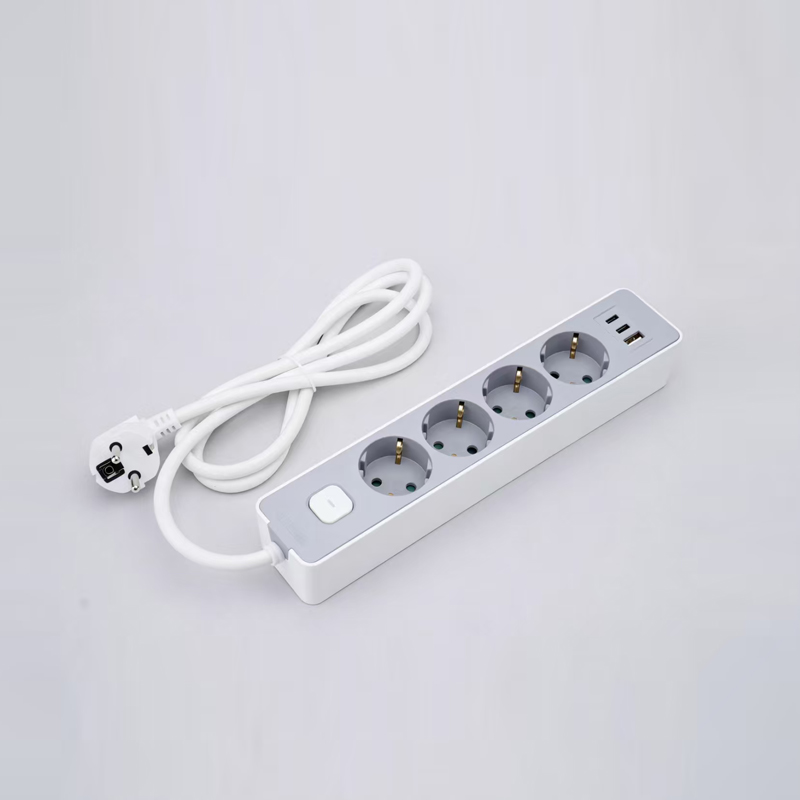
A universal travel power strip is specifically designed for international use. These strips feature a built-in voltage conversion capability (100–240V input), accept plugs from multiple countries on the output side, and include USB charging ports. They typically support European (Type C/F), UK (Type G), US (Type A/B), and Australian (Type I) plugs. This is the most convenient all-in-one solution for travelers.
Option 2: Voltage Converter + Plug Adapter
If you need to use your existing American power strip in Europe, you can plug it into a step-down voltage converter (240V to 120V) and then connect the converter to a European outlet using a plug adapter. The converter steps the voltage down to a safe 120V level before it reaches your power strip. Note that converters are bulky, heavy, and rated for specific wattage limits — ensure the converter's wattage rating exceeds the total load of all devices you plan to connect.
Option 3: Dual-Voltage American Power Strip + Plug Adapter
If your American power strip is rated 100–240V (check the label), you only need a plug adapter — no voltage converter required. The power strip handles the voltage internally. Simply attach a Type C, E/F, or G plug adapter (depending on the country) and you are good to go.
Comparing Your Options for Using Power Strips in Europe
| Solution | Voltage Handled? | Plug Adapter Needed? | Cost (Approx.) | Best For |
| US power strip (120V only) + adapter only | No — UNSAFE | Yes | $5–$15 | Not recommended |
| Dual-voltage US power strip (100–240V) + adapter | Yes — Safe | Yes | $10–$20 (strip) + $5 (adapter) | Travelers with a compatible strip |
| Universal travel power strip | Yes — Built-in | No | $25–$60 | Most travelers |
| Step-down voltage converter + US power strip + adapter | Yes — External | Yes | $30–$80 (converter) | High-wattage appliances |
Table 2: Overview of solutions for safely using power strips in Europe, with cost and safety comparison
European Plug Types by Country: What Adapter Do You Need?
Europe is not uniform — different countries use different plug types, so the specific adapter you need depends on your destination. Below is a quick reference for the most visited European countries:
| Country | Plug Type | Voltage | Frequency |
| Germany, France, Spain, Italy (most of continental Europe) | Type C / Type E / Type F | 230V | 50Hz |
| United Kingdom | Type G | 230V | 50Hz |
| Switzerland | Type J | 230V | 50Hz |
| Denmark | Type K | 230V | 50Hz |
| Italy (older outlets) | Type L | 230V | 50Hz |
Table 3: Plug types and voltage standards for popular European countries
If you are visiting multiple European countries in one trip, a universal travel power strip or a multi-country adapter kit is your most practical choice, as it covers all plug types in a single purchase.
What Devices Are Safe to Use in Europe Without a Converter?
Most modern consumer electronics — laptops, smartphones, tablets, and camera chargers — are dual-voltage (100–240V) and only need a plug adapter, not a voltage converter. This includes the vast majority of chargers produced since the early 2000s. Always check the fine print on the device's power brick or charging cable.
Devices That Are Typically Dual-Voltage (Safe with Adapter Only)
- Laptop chargers and power bricks
- Smartphone and tablet chargers (USB-A and USB-C)
- Digital camera battery chargers
- Most modern portable speakers and headphone chargers
- Electric toothbrush chargers (most modern models)
Devices That Are Often Single-Voltage (Need a Converter)
- Older or budget hair dryers and curling irons (often 120V only)
- Certain kitchen appliances (blenders, coffee makers)
- Some power tools
- Older clock radios or alarm clocks with built-in motors
- Standard US power strips (most common models)
Safety Risks of Using the Wrong Power Equipment
Using an incompatible American power strip in Europe without proper voltage conversion poses serious safety risks, including electrical fires, device destruction, and electric shock. Here is what can realistically happen:
- Immediate overload: The 240V supply instantly overwhelms the 120V-rated internal components, potentially causing a spark or small arc when plugged in.
- Surge protector failure: MOVs (metal-oxide varistors) inside surge-protecting power strips are calibrated for 120V peaks. At 240V, they can fail catastrophically — often with a loud pop, smoke, or fire.
- Device damage: Any device plugged into the strip (laptop, phone, camera) can be damaged or destroyed, even if the device itself is rated for dual voltage.
- Fire hazard: Overheated wiring insulation inside the power strip can ignite, especially in enclosed spaces like hotel rooms. The National Fire Protection Association (NFPA) reports that electrical fires cause approximately 51,000 house fires annually in the US — most are preventable with proper equipment.
Practical Tips for Charging Multiple Devices in Europe
With the right equipment and approach, charging all your devices in Europe is easy and safe. Use these practical guidelines:
- Invest in a quality universal travel power strip before your trip. Look for one rated 100–240V with built-in surge protection, multiple USB-A and USB-C ports, and a compact design. A single outlet in a European hotel room becomes five or six charging points.
- Check every device before packing. Read the input label on each charger or device. If it says 100–240V, pack a plug adapter. If it says 120V only, either leave it at home or bring a step-down converter.
- Pack country-specific adapters if visiting only one or two countries. A universal adapter is convenient for multi-country trips; individual adapters are lighter and cheaper for single-destination travel.
- Do not overload your power strip. Even a dual-voltage or universal strip has a maximum wattage rating. European outlets typically supply 10–16 amps at 230V, meaning you can draw up to approximately 2,300–3,680 watts. However, most travel strips are rated for far less — typically 1,500–2,500W. Avoid plugging high-wattage appliances (hair dryers, kettles) into travel strips.
- Never use a power strip with a power strip. Daisy-chaining power strips is a fire hazard in any country. Always plug directly into a wall outlet.
Frequently Asked Questions (FAQ)
Can I use a US power strip in Europe with just a plug adapter?
Only if the power strip is rated for 100–240V. If it is rated for 120V only, a plug adapter alone is not safe. The adapter changes the plug shape but does not change the voltage, which will remain at 240V — well above the strip's rating.
What happens if I plug a 120V power strip into a 240V European outlet?
In most cases, the strip's internal components will fail instantly or within seconds. This can manifest as a burning smell, sparks, smoke, or in extreme cases, a fire. Every device plugged into the strip at the time is also at risk of being destroyed.
Do I need a voltage converter or just a plug adapter for my laptop in Europe?
Almost certainly just a plug adapter. Nearly all modern laptop chargers are rated 100–240V. Check the label on your laptop's power brick — if it lists "Input: 100–240V ~ 50/60Hz," you only need a physical plug adapter to connect to a European outlet.
Is the UK the same as the rest of Europe for plugs and voltage?
The UK uses the same 230V/50Hz standard as continental Europe, but it uses a completely different plug type — Type G (three rectangular prongs). If you are visiting both the UK and continental Europe, you will need two different plug adapters, or a universal adapter that covers both.
Can I use a European power strip in the United States?
The same principle applies in reverse. A European power strip rated for 230V cannot be safely used in a US 120V outlet without a step-up converter, and the plug shape will not fit without an adapter. However, if the European strip is rated 100–240V, it can work with a plug adapter in the US.
What is the best power strip to bring to Europe from the US?
The best option is a dedicated universal travel power strip rated 100–240V, 50/60Hz, with built-in adapters for multiple countries, multiple USB ports, and surge protection. These are designed specifically for international travelers and eliminate the need for separate adapters and converters.
How many watts can a European outlet supply?
A standard European household outlet supplies 230V at 10–16 amps, giving a maximum capacity of approximately 2,300–3,680 watts. By comparison, a US outlet at 120V and 15A provides a maximum of 1,800 watts. Keep this in mind when connecting high-draw devices through your power strip.
Are surge protectors necessary in Europe?
Surge protection is always a good idea regardless of where you travel. European electrical infrastructure is generally reliable, but voltage spikes can still occur. If you are traveling with a universal travel power strip, look for one that explicitly includes surge protection rated for 240V.
Conclusion
Using an American power strip in Europe is not safe unless the strip is explicitly rated for 100–240V and you have the correct plug adapter for your destination country. The vast majority of standard US power strips are designed for 120V only and will fail dangerously when exposed to European 240V electricity. The safest and most convenient solution for travelers is to invest in a universal travel power strip designed for global use. Always check your device labels, never rely on a plug adapter alone to solve voltage incompatibility, and never daisy-chain power strips. With the right preparation, keeping all your devices charged across Europe is straightforward and completely safe.