

 English
  中文简体
中文简体 


Yes, you can use a power strip in Europe — but only under specific conditions. If your power strip is rated for 100–250V and you attach a single plug adapter to the strip's own plug, it will work safely on Europe's 220–240V electrical system. However, if your power strip is rated for 110–120V only (as most North American strips are), plugging it into a European outlet without a voltage converter will damage the strip, trip a breaker, or create a fire hazard.
This guide explains exactly what to check, what to buy, how to travel safely with a power strip in Europe, and which scenarios require a voltage converter rather than just a plug adapter.
Content
- Why Europe's Electricity Is Different from North America
- How to Check If Your Power Strip Is Safe for Europe
- Using a Dual-Voltage Power Strip in Europe: The Correct Setup
- When You Need a Voltage Converter Instead of Just an Adapter
- Plug Adapter vs. Voltage Converter vs. Travel Power Strip: Which Do You Need?
- Which Plug Type Do You Need for Europe?
- Safety Rules When Using a Power Strip in Europe
- What to Look for When Buying a Travel Power Strip for Europe
- Real-World Scenarios: Using a Power Strip in Europe
- Frequently Asked Questions: Power Strips in Europe
- Q: Can I bring my US power strip to Europe without a converter?
- Q: Will a plug adapter damage my electronics?
- Q: Is it legal to use a power strip in a European hotel room?
- Q: What happens if I plug a 120V power strip into a 240V European outlet?
- Q: Do I need a grounded adapter for my power strip in Europe?
- Q: How many devices can I safely plug into one European outlet via a power strip?
- Summary: The Right Approach to Using a Power Strip in Europe
Why Europe's Electricity Is Different from North America
The core difference is voltage and plug shape: Europe runs on 220–240V at 50Hz, while the United States and Canada run on 110–120V at 60Hz — and European outlets use round two- or three-pin plugs (Type C, E, or F) that are physically incompatible with North American flat-blade plugs.
These differences have two separate implications when traveling with a power strip:
- Physical incompatibility (plug shape): Your North American power strip has flat-blade plugs that will not physically fit into European sockets. This is solved with a plug adapter — a simple, inexpensive converter that changes the plug shape without altering voltage.
- Electrical incompatibility (voltage): If your power strip's internal wiring and surge protection components are only rated for 110–120V, connecting them to 220–240V will cause immediate failure — and potentially fire. This requires either a dual-voltage power strip or a step-down voltage converter.
A plug adapter only changes the physical shape of the plug. It does not change the voltage. This is the single most misunderstood point that causes damaged electronics and blown fuses in European hotel rooms every year.
How to Check If Your Power Strip Is Safe for Europe
The voltage rating printed on your power strip's label — not on the individual devices you plug into it — is the only specification that determines whether it can be used safely in Europe.
Follow these steps:
- Locate the label — usually printed on the bottom or side of the power strip housing, or on a tag near the plug.
- Find the voltage rating. Look for text such as:
- "INPUT: 100–250V ~50/60Hz" — Safe for Europe. This is a dual-voltage or universal-voltage strip.
- "INPUT: 125V ~60Hz" or "120V AC" — Not safe for Europe without a step-down converter.
- "INPUT: 110–240V" — Safe for Europe.
- Check the amperage rating. European outlets typically provide 16A circuits. Ensure the power strip's rated amperage does not exceed the outlet's capacity when all plugged-in devices are running simultaneously.
- Check the surge protection rating if your strip has one. Many surge protectors are calibrated for 110–120V — their metal oxide varistors (MOVs) will fail immediately on 240V. Even if the strip itself is dual-voltage, confirm the surge protection component also covers 240V.
If no label is visible or the text is worn away, treat the strip as incompatible and do not use it in Europe. The cost of a new travel power strip is far less than replacing a laptop or repairing a hotel room outlet.
Using a Dual-Voltage Power Strip in Europe: The Correct Setup
The safest and most practical setup for travelers is a single plug adapter attached to the power strip's own plug, allowing all devices — regardless of their own plug shape — to charge simultaneously from one European outlet.
Here is the correct configuration step by step:
- Confirm your dual-voltage power strip is rated 100–250V (see Section 2 above).
- Attach one Type C, E, or F plug adapter to the power strip's flat-blade plug. For most of continental Europe, a Type C (two round pins) adapter is sufficient. For Germany, France, Belgium, and Poland, a Type E or F (two round pins with grounding) adapter provides a grounded connection.
- Plug the adapter into the European wall outlet.
- Plug all your devices into the power strip's outlets — your North American or other flat-blade plugs fit directly into the strip's receptacles as normal.
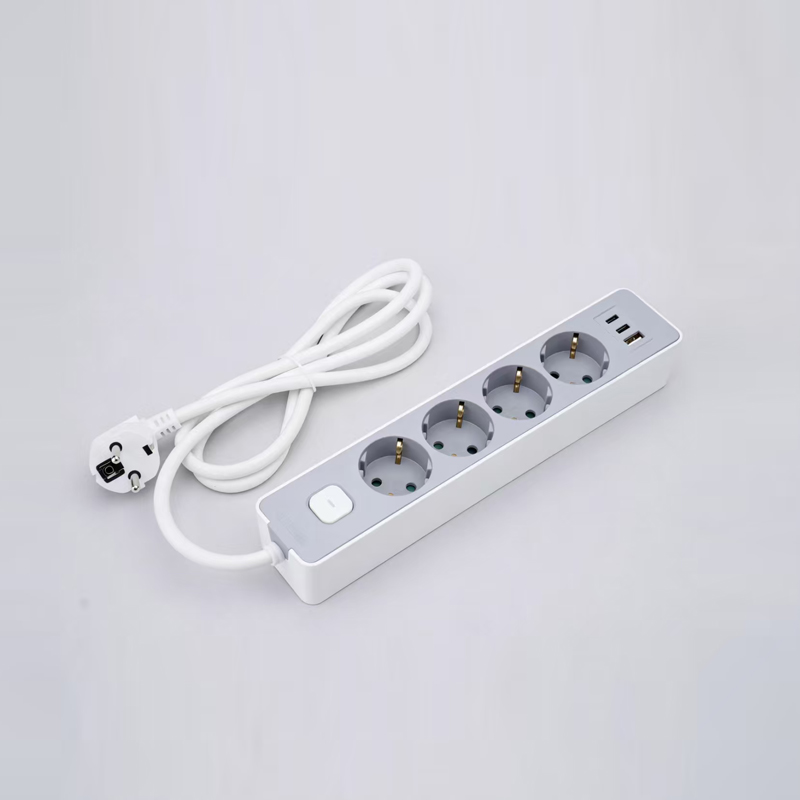
This approach eliminates the need for multiple adapters — one adapter serves all your devices. A typical travel power strip with 4–6 outlets and 2–3 USB ports can charge a laptop, smartphone, tablet, camera, and e-reader simultaneously from a single European hotel outlet. This is particularly valuable in older European hotels where available outlets near the bed or desk may be limited to one or two.
When You Need a Voltage Converter Instead of Just an Adapter
You need a voltage converter — not just a plug adapter — whenever any device in your travel kit is single-voltage (110–120V only) and cannot accept European 220–240V input.
Common single-voltage devices that require a converter in Europe include:
- North American hair dryers and flat irons — typically rated 110–120V only. These are among the most commonly damaged appliances in European hotels.
- Electric shavers (older models) — many budget shavers are 120V only, though most modern shavers are now dual-voltage.
- Some kitchen appliances — travel coffee makers, immersion heaters, and electric kettles sold in North America are typically single-voltage.
- Single-voltage power strips — as discussed, a 120V-rated power strip connected to a 240V outlet will fail dangerously.
Note that most modern electronics — laptops, smartphones, tablets, cameras, and their chargers — are universally dual-voltage. Their power bricks typically read "INPUT: 100–240V ~50/60Hz," meaning they self-adjust to any voltage worldwide. For these devices, only a plug adapter (not a converter) is needed. Plugging a dual-voltage device into a step-down converter is harmless but unnecessary.
Plug Adapter vs. Voltage Converter vs. Travel Power Strip: Which Do You Need?
Understanding which solution you need prevents both equipment damage and unnecessary expense — most modern travelers only need a plug adapter or a dual-voltage travel power strip, not a heavy voltage converter.
| Solution | Changes Plug Shape | Changes Voltage | Typical Weight | Typical Cost | Best For |
|---|---|---|---|---|---|
| Plug Adapter | Yes | No | 20–50 g | $5–$15 | Dual-voltage devices only |
| Voltage Converter | Sometimes | Yes (240V → 120V) | 300 g – 2 kg | $20–$80 | Single-voltage appliances (hair dryers, etc.) |
| Dual-Voltage Travel Power Strip | With one adapter | No (accepts both) | 150–300 g | $20–$45 | Multiple dual-voltage devices simultaneously |
| Universal Travel Adapter (multi-region) | Yes (150+ countries) | No | 80–150 g | $15–$35 | Frequent international travelers, 1–2 devices |
Table 1: Comparison of plug adapters, voltage converters, dual-voltage travel power strips, and universal adapters across five key criteria for European travel.
Which Plug Type Do You Need for Europe?
Most of continental Europe uses Type C, E, or F plugs — and a Type C adapter will physically fit the majority of European outlets, though a grounded Type E/F is safer and more secure for high-draw devices.
Europe is not uniform in its plug standards. Here is a country-by-country breakdown of the plug types you'll encounter:
| Country / Region | Plug Type | Voltage | Frequency | Notes |
|---|---|---|---|---|
| Germany, Austria, Netherlands, Sweden, Norway | Type F (Schuko) | 230V | 50Hz | Type C fits in Type F sockets (ungrounded) |
| France, Belgium, Poland, Slovakia | Type E | 230V | 50Hz | Has a protruding ground pin; Type C fits but is ungrounded |
| United Kingdom, Ireland | Type G | 230V | 50Hz | Unique three rectangular-blade plug; separate adapter required |
| Italy | Type F / Type L | 230V | 50Hz | Older buildings may have 3-round-pin (Type L) sockets only |
| Switzerland | Type J | 230V | 50Hz | 3-round-pin in triangular layout; Type C fits most sockets |
| Denmark | Type K | 230V | 50Hz | Type C fits ungrounded; Type K adapter for grounded use |
Table 2: Plug types, voltages, and frequencies by European country — critical information when selecting the correct adapter for your power strip.
If you are visiting multiple European countries in one trip, a universal travel adapter covering Types C, E, F, G, and J eliminates the need for multiple country-specific adapters. One universal adapter on your travel power strip handles the UK, continental Europe, and Switzerland simultaneously.
Safety Rules When Using a Power Strip in Europe
Electrical safety when traveling with a power strip in Europe requires following five non-negotiable rules that prevent fires, equipment damage, and personal injury.
- Never daisy-chain power strips. Plugging one power strip into another multiplies the load on a single outlet and creates a serious overload and fire hazard. European hotel circuits are typically rated at 16A — connecting two power strips can easily exceed this limit, especially if one strip powers a laptop charger and another powers high-draw appliances.
- Do not exceed the strip's rated amperage. Add up the current draw (in amps) of all devices plugged into the strip simultaneously. A standard dual-voltage travel power strip rated at 10A at 250V delivers a maximum of 2,500W — more than enough for typical travel electronics, but insufficient for high-wattage appliances like hair dryers (1,500–2,000W) or travel irons (1,000–2,000W).
- Keep the power strip flat and uncovered during use. Heat buildup under bedding, inside luggage, or in enclosed spaces is a leading cause of power strip fires globally. Always use a power strip in an open, ventilated location.
- Use a power strip with surge protection rated for 240V. European voltage spikes and fluctuations are real — particularly in older buildings in Southern and Eastern Europe. A surge protector rated for 100–250V absorbs transient spikes that would otherwise reach your laptop or camera battery.
- Inspect the adapter connection before each use. A loose adapter on a power strip plug creates an arcing point — a source of heat and potential fire. Ensure the adapter is firmly seated and does not wobble in the wall socket before plugging in high-draw devices.
What to Look for When Buying a Travel Power Strip for Europe
The best travel power strip for Europe combines universal voltage compatibility, compact size, USB-A and USB-C charging ports, and a safety-certified design — all in a package under 300 grams.
- Universal voltage rating (100–250V, 50/60Hz): This is non-negotiable. Confirm it explicitly on the product label or specification sheet before purchasing.
- USB-C Power Delivery (PD) port: Modern laptops (MacBook, Dell XPS, Lenovo ThinkPad) and flagship smartphones charge fastest via USB-C PD at 30–65W. A travel power strip with an integrated USB-C PD port eliminates the need to carry a separate laptop wall charger entirely.
- Compact form factor: Flat or right-angle plugs are less likely to block adjacent sockets in double-outlet European wall plates. A strip measuring under 18 cm in length fits in most hotel safes and day bags without difficulty.
- Safety certifications: Look for CE marking (required for European market) and certifications such as RoHS compliance. Strips with a built-in resettable circuit breaker (vs. a one-time fuse) are preferable — if overloaded, you press a button to restore power rather than replacing a fuse.
- Adequate outlet count: For a typical traveler carrying a laptop, smartphone, tablet, and camera, a strip with 3 AC outlets + 2–3 USB ports covers all charging needs simultaneously from one wall socket.
- Grounded (3-pin) plug: A grounded travel power strip provides safer operation for grounded devices (laptops, certain camera chargers). The strip's own plug receives ground from the European wall socket and passes it to grounded plugs inserted into the strip's receptacles.
Real-World Scenarios: Using a Power Strip in Europe
Understanding common travel situations helps you plan your power setup before you arrive — eliminating the scramble for adapters in a foreign hotel room at midnight.
Scenario 1: Business Traveler with Laptop, Phone, and Tablet
You have a dual-voltage laptop charger (100–240V), a dual-voltage phone charger, and a dual-voltage tablet charger. Your hotel room in Paris has one accessible outlet near the desk. Solution: one dual-voltage travel power strip + one Type E/F adapter. Total weight added to luggage: approximately 250 grams. All three devices charge simultaneously with no converters needed. Cost of the setup: $25–$40.
Scenario 2: Traveler with a North American Hair Dryer
Your hair dryer is rated 120V only (printed on the handle). A plug adapter alone will destroy it immediately on European 240V. Options: (1) Purchase a step-down voltage converter rated at 1,500–2,000W to power the hair dryer — these converters weigh 400–700g and cost $20–$50. (2) Use the hotel's own hair dryer (most European hotels provide them, typically rated 1,200–2,000W at 230V). (3) Replace the hair dryer with a dual-voltage model rated 100–240V before travel. Option 3 is recommended for frequent travelers — the weight and bulk of carrying a converter for one appliance rarely makes economic sense on multiple trips.
Scenario 3: Multi-Country European Tour (UK + France + Germany + Italy)
Each country has a different plug type. The UK uses Type G; France uses Type E; Germany and Italy use Type F. Solution: a universal travel adapter (covering G, E, F, and C) attached to a dual-voltage power strip covers all four countries with a single adapter. Alternatively, carry three country-specific adapters and swap them as you travel. The single universal adapter approach saves space and eliminates confusion — but confirm the universal adapter's rated current (many cap at 6A or 2,500W, which is sufficient for electronics but not for high-wattage appliances).
Frequently Asked Questions: Power Strips in Europe
Q: Can I bring my US power strip to Europe without a converter?
Only if it is rated for 100–250V. Check the label on your power strip. If it reads "125V" or "120V" only, you cannot use it safely in Europe without a step-down voltage converter. Most power strips sold in North American retail stores are 120V only and are not safe for European use without conversion. Travel-specific power strips sold online and in travel retailers are commonly dual-voltage and safe for Europe with only a plug adapter.
Q: Will a plug adapter damage my electronics?
A plug adapter does not damage dual-voltage electronics because it only changes the physical plug shape — it does not alter voltage. If your device or power strip is rated 100–240V, the European 230V supply is within its operating range and the adapter is completely safe. The risk of damage applies only when a single-voltage (110–120V only) device is connected to European power with only an adapter and no voltage converter.
Q: Is it legal to use a power strip in a European hotel room?
Using a properly rated travel power strip in a European hotel room is legal and widely practiced. However, some hotels — particularly in the UK and older continental European properties — explicitly prohibit high-wattage appliances such as kettles, irons, and hotplates in rooms due to wiring limitations. A travel power strip used only for charging electronics well within the outlet's rated current (typically 16A at 230V = 3,680W maximum) raises no safety or legal issues. When in doubt, ask the front desk.
Q: What happens if I plug a 120V power strip into a 240V European outlet?
Plugging a 120V power strip into a 240V outlet will likely cause immediate failure — and potentially fire or injury. The internal wiring insulation, surge protection components (MOVs), and circuit breaker are all calibrated for 120V. On 240V, the MOVs absorb the excess energy and fail catastrophically — sometimes producing smoke or flame. The circuit breaker, if present, may trip but cannot always respond fast enough to prevent component damage. Never attempt this. The 2× voltage increase delivers 4× the power to resistive components, overwhelming them instantly.
Q: Do I need a grounded adapter for my power strip in Europe?
A grounded (Type E or Type F) adapter is recommended but not always essential — it depends on the devices you are charging and the country you are visiting. For laptop chargers and camera chargers that have three-prong plugs at home, a grounded adapter provides the intended level of electrical protection. For two-prong device chargers (many phone chargers), a Type C ungrounded adapter is electrically equivalent to what you use at home. In Germany, France, Belgium, and other countries with Type E or F sockets, using a grounded adapter also gives a more physically secure connection — the grounded pins lock the adapter into the recessed socket housing.
Q: How many devices can I safely plug into one European outlet via a power strip?
You can safely power as many devices as fit within the European outlet's rated circuit capacity — typically 16A at 230V, equal to a maximum of 3,680W total load. A practical travel load of one laptop (45–65W), one smartphone (18–25W), one tablet (30–45W), and one camera charger (10–20W) totals approximately 130–155W — less than 5% of the available circuit capacity. Even adding a travel CPAP machine (30–100W) or a compact travel iron (1,000W rated for 240V) stays well within safe limits. The only risk scenario is connecting high-wattage appliances — multiple 1,500W hair dryers, for instance — simultaneously.
Summary: The Right Approach to Using a Power Strip in Europe
Using a power strip in Europe is straightforward once you understand the two separate issues — plug shape and voltage. For most modern travelers whose devices are already dual-voltage, a single dual-voltage travel power strip with one plug adapter covers every charging need from a single European wall outlet, saving the frustration of hunting for spare sockets in hotel rooms.
The key rules to remember: always verify the 100–250V rating on the strip label before plugging into any European outlet; use only one adapter on the strip's own plug rather than multiple adapters on individual devices; never exceed the strip's rated wattage; and replace any single-voltage appliances (hair dryers, irons) with dual-voltage alternatives before your trip to eliminate the need for heavy, expensive voltage converters entirely.
With the right travel power strip for Europe in your bag — one that is compact, universally rated, and equipped with USB-C Power Delivery — you will arrive at any European destination fully prepared to charge all your devices safely, efficiently, and without compromise.