

 English
  中文简体
中文简体 


US power strips can be physically connected to European outlets using a plug adapter, but doing so carries serious risks and is generally not recommended without proper precautions. The core problem is voltage: the US runs on 110–120V while Europe uses 220–240V. Plugging a standard American power strip into a European wall socket exposes every device connected to it — and the strip itself — to twice the intended voltage, which can cause overheating, permanent damage, or fire. This guide explains exactly when it is safe, when it is not, and what to use instead.
Content
- 1. The Voltage Problem Explained
- 2. Dual-Voltage Power Strips: The Exception to the Rule
- 3. Plug Adapters vs Voltage Converters: Understanding the Difference
- 4. Surge Protection and European Voltage
- 5. Which Devices Are Safe to Plug Into a US Power Strip in Europe
- 6. Real Risks of Using a US Power Strip in Europe
- 7. Safer Alternatives to Consider
- 8. Comparison at a Glance
- 9. Frequently Asked Questions
- Key Takeaways
1. The Voltage Problem Explained
The fundamental incompatibility between US and European power systems is voltage, not just plug shape. Understanding this difference is essential before attempting to use any US electrical equipment in Europe.
US vs European Electrical Standards
The United States operates on a 120V / 60Hz electrical system. Europe — including countries in the EU, UK (230V/50Hz), and most of the continent — runs on 220–240V / 50Hz. That means a European wall outlet delivers roughly twice the voltage of an American one.
A standard US power strip is designed and rated for 120V operation. Its internal wiring, circuit breaker, surge components, and outlet sockets are all built to handle current at that voltage. When 240V is applied to a 120V-rated power strip, the electrical load on every component doubles instantaneously. In many cases, the strip will either fail immediately or — more dangerously — continue to operate while overheating internally, creating a slow-burn fire risk.
Frequency Difference: Does 50Hz vs 60Hz Matter?
For most modern devices, the frequency difference between 50Hz (Europe) and 60Hz (US) is a minor issue compared to voltage. Simple resistive loads like toasters and hair dryers are affected by frequency to some extent, but universal switching-power-supply devices — laptops, phone chargers, and most modern electronics — handle both 50Hz and 60Hz without issue. The voltage gap, however, is never minor and cannot be ignored.
2. Dual-Voltage Power Strips: The Exception to the Rule
Some US-sold power strips are rated for both 100–240V input, making them genuinely safe to use in Europe with only a plug adapter. These are the only American power strips that can be used in Europe without a voltage converter.
To determine whether your power strip is dual-voltage, look for a label on the strip itself — usually printed near the cord or on the bottom of the unit. It will say one of the following:
- Input: 100–240V ~ — Safe for worldwide use including Europe
- Input: 120V only — Not safe for European outlets without a converter
- Input: 110–120V — Not safe for European use
- No label visible — Assume 120V only; do not use in Europe
Dual-voltage power strips are less common in standard retail but are sold specifically as travel power strips. They typically include USB charging ports, 2–4 AC outlets, and compact form factors suited for hotel rooms. If you purchase a travel-oriented power strip from a reputable source and it is labeled 100–240V, it is safe to plug into a European wall outlet via a Type C, E, or F adapter (the standard European plug types).
Important note: Even a dual-voltage power strip rated for 240V input will still have US-style Type A or Type B sockets on its face. Devices with US plugs can be plugged directly into these sockets. European devices with Type C or Schuko plugs cannot — you would need additional adapters for those.
3. Plug Adapters vs Voltage Converters: Understanding the Difference
A plug adapter only changes the physical shape of the plug — it does not change the voltage, and it will not protect a 120V power strip from 240V European current. This is one of the most common and dangerous misconceptions among travelers.
What a Plug Adapter Does
A plug adapter is purely a mechanical interface. It allows a US two-prong (Type A) or three-prong (Type B) plug to physically fit into a European socket (Type C, E, F, G, etc.). The full 220–240V supply from the wall passes through unchanged. If your power strip is rated at 120V, every one of those volts will reach it.
What a Voltage Converter Does
A voltage converter (also called a step-down transformer) actively reduces the incoming 220–240V to 110–120V before passing it to your device. A 500W–1,000W step-down converter costs approximately $25–$60 and is capable of safely powering a US power strip in Europe — as long as the total wattage of all connected devices does not exceed the converter's rated capacity.
For example: if you use a 500W converter and connect a laptop (65W), a phone charger (20W), and a tablet charger (30W), your total load is 115W — well within the converter's limit. Attempting to add a hair dryer (1,200–1,800W) to that same setup would immediately exceed the converter's rating and likely damage it.
Step-Down Converter Limitations
- Converters add bulk and weight — most weigh between 400g and 1.5kg
- They must be rated for the total wattage of all connected devices
- Some converters produce a modified sine wave, which can cause issues with sensitive electronics
- They add an additional point of failure and heat generation to your setup
4. Surge Protection and European Voltage
The surge protection components inside a US power strip are calibrated for 120V and will fail — or fail to protect — when exposed to 240V. This is a critical point that many guides overlook.
Most US power strips with surge protection use Metal Oxide Varistors (MOVs) rated to clamp excess voltage above approximately 330–400V (relative to 120V nominal). When 240V becomes the baseline input, these MOVs are operating far outside their design parameters. Two things can happen:
- Immediate failure: The MOV clamps the voltage as if it were a surge, burns out instantly, and the strip may spark or blow its internal fuse.
- Silent degradation: The MOV operates in a constant stressed state, heating the strip from within without any visible indication — the most dangerous scenario.
In either case, the surge protection that you paid for is rendered useless. Even if the strip appears to function normally, you have no guarantee that your connected devices are protected from power spikes on the European grid. European power grids are generally stable, but transient spikes do occur — particularly in older buildings or regions with aging infrastructure.
5. Which Devices Are Safe to Plug Into a US Power Strip in Europe
If you are using a dual-voltage US power strip (100–240V) in Europe, the safety of connected devices depends entirely on whether those devices are themselves rated for 240V.
The good news is that most modern consumer electronics use universal power supplies and are rated 100–240V. The label on the device's power brick or charging adapter is the definitive source of truth.
Devices That Are Typically Safe (Check Label to Confirm)
- Laptops and notebook computers (nearly all modern models: 100–240V)
- Smartphones and tablets (USB-C and USB-A chargers: usually 100–240V)
- Digital cameras and action cameras
- E-readers and portable speakers
- CPAP machines (most travel-grade models: 100–240V)
- Most electric shavers (check label)
Devices That Are NOT Safe Without a Converter
- Hair dryers (120V only): These will overheat and burn out within seconds on 240V
- Curling irons and flat irons: Same risk as hair dryers; very high failure rate on 240V
- Electric kettles and coffee makers: Resistive heating elements are fixed-voltage
- Older desktop computers: Many have fixed 120V power supplies
- Power tools: Almost always single-voltage
- Gaming consoles (older models): Check the back panel — some older units are 120V only
6. Real Risks of Using a US Power Strip in Europe
The risks range from destroyed electronics to electrical fires — and travel insurance or manufacturer warranties rarely cover damage caused by voltage incompatibility.
- Device destruction: A 120V-only device connected to 240V will typically fail within seconds. Internal components — capacitors, transformers, rectifiers — burn out from the excess current draw.
- Fire hazard: Overheated wiring inside the power strip can ignite surrounding materials. Hotel rooms and short-term rentals rarely have fire-suppression systems capable of catching a localized electrical fire before it spreads.
- Tripped breakers: Even if no fire occurs, the sudden overload may trip the circuit breaker for your room — cutting power to the entire space including refrigerators, air conditioning, and alarm systems.
- Voided warranty: Virtually every electronics manufacturer voids the product warranty for damage caused by operating the device outside its rated voltage range. Misuse of electrical standards is explicitly excluded from coverage in most warranty terms.
- No insurance coverage: Travel insurance typically does not cover self-caused electrical damage. If a fire results, liability may fall on the traveler, with significant financial consequences.
7. Safer Alternatives to Consider
The safest and most practical solution for travelers is to purchase a travel power strip explicitly rated for 100–240V input, rather than attempting to adapt an existing US model for European use.
Option 1: Universal Travel Power Strip (Recommended)
A compact travel power strip rated for 100–240V input, with 2–4 AC outlets and 2–4 USB ports, costs approximately $25–$50 and is the cleanest solution for international travel. You need only a single plug adapter (Type C or F for most of Europe) to connect the strip to the wall. All devices with US plugs can then connect directly to the strip's Type A/B face outlets. These strips typically weigh under 300g and are specifically designed for this scenario.
Option 2: Step-Down Voltage Converter + US Power Strip
If you must use an existing US power strip, a step-down converter rated above the total wattage of your connected devices will reduce 240V to 120V safely. This approach works but adds cost ($25–$60 for the converter), weight (400g–1.5kg), and complexity. It is best suited for situations where you have a specific high-wattage 120V device that has no dual-voltage equivalent.
Option 3: Buy a European Power Strip Locally
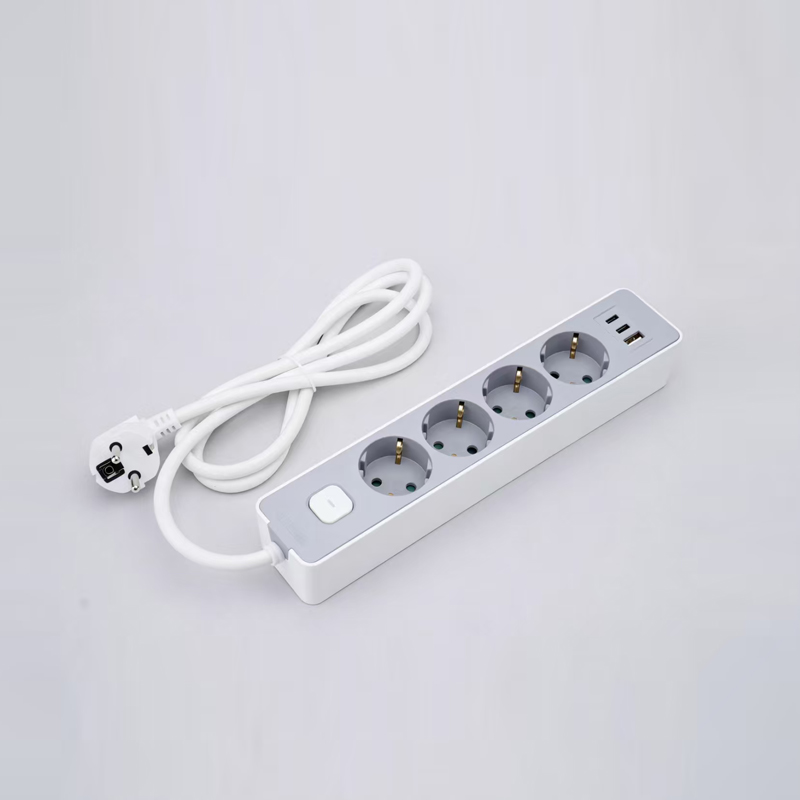
For extended stays — internships, study abroad, relocations — purchasing a local European power strip (Schuko or UK-standard depending on country) eliminates all compatibility concerns. European power strips cost roughly EUR 10–30 for a quality unit and are widely available at hardware stores, supermarkets, and electronics retailers. This is the most cost-effective solution for stays of one month or longer.
Option 4: USB Charging Hub
If your primary need is to charge multiple devices simultaneously, a compact USB charging hub rated for 100–240V input is often the best solution. Many modern hubs offer 4–6 USB-A or USB-C ports, fast-charging protocols (up to 65–100W total), and weigh under 200g. With a single plug adapter, these cover most travelers' charging needs without any voltage concerns.
8. Comparison at a Glance
Use the table below to compare each approach for using power strips in Europe — from the safest to the most risky options.
| Approach | Voltage Safe? | Equipment Needed | Approx. Cost | Best For |
| Universal travel power strip (100–240V) | Yes | Plug adapter only | $25–$50 | All travelers |
| Buy local European power strip | Yes | Nothing extra | EUR 10–30 | Long-term stays |
| US power strip (120V) + step-down converter | Conditional | Converter + adapter | $25–$60 extra | Specific 120V devices |
| USB charging hub (100–240V) | Yes | Plug adapter only | $20–$45 | Phone / laptop charging |
| US power strip (120V) + plug adapter only | No — Dangerous | Adapter only | $5–$15 | Not recommended |
| US power strip (120V) with no adapter | Not applicable | Will not fit physically | — | Cannot connect |
Table 1: Comparison of methods for using US power strips in Europe, rated by safety, cost, and use case suitability.
| Country / Region | Voltage | Frequency | Plug Type | US Strip Safe (120V only)? |
| United States | 120V | 60Hz | Type A / B | Yes |
| Germany / France / Italy | 230V | 50Hz | Type C / E / F | No |
| United Kingdom | 230V | 50Hz | Type G | No |
| Spain / Portugal | 230V | 50Hz | Type C / F | No |
| Switzerland | 230V | 50Hz | Type J | No |
| Scandinavia (Norway / Sweden / Denmark) | 230V | 50Hz | Type C / F | No |
Table 2: Electrical standards by country — a quick-reference guide for US travelers checking whether their power strip is compatible.
9. Frequently Asked Questions
Key Takeaways
- Check the label first: If your US power strip says 100–240V, it is safe in Europe with a plug adapter.
- A plug adapter is not a voltage converter — it changes the plug shape only, not the electrical supply.
- 120V-only strips must never be used on European 230–240V outlets — even briefly.
- Most modern laptops and phone chargers are dual voltage — verify by checking their power bricks.
- Hair dryers, curling irons, and resistive appliances are almost never dual voltage.
- The best solution for travelers is a purpose-built 100–240V travel power strip or USB charging hub.
- For long-term stays, buying a local European power strip eliminates all compatibility issues.