

 English
  中文简体
中文简体 


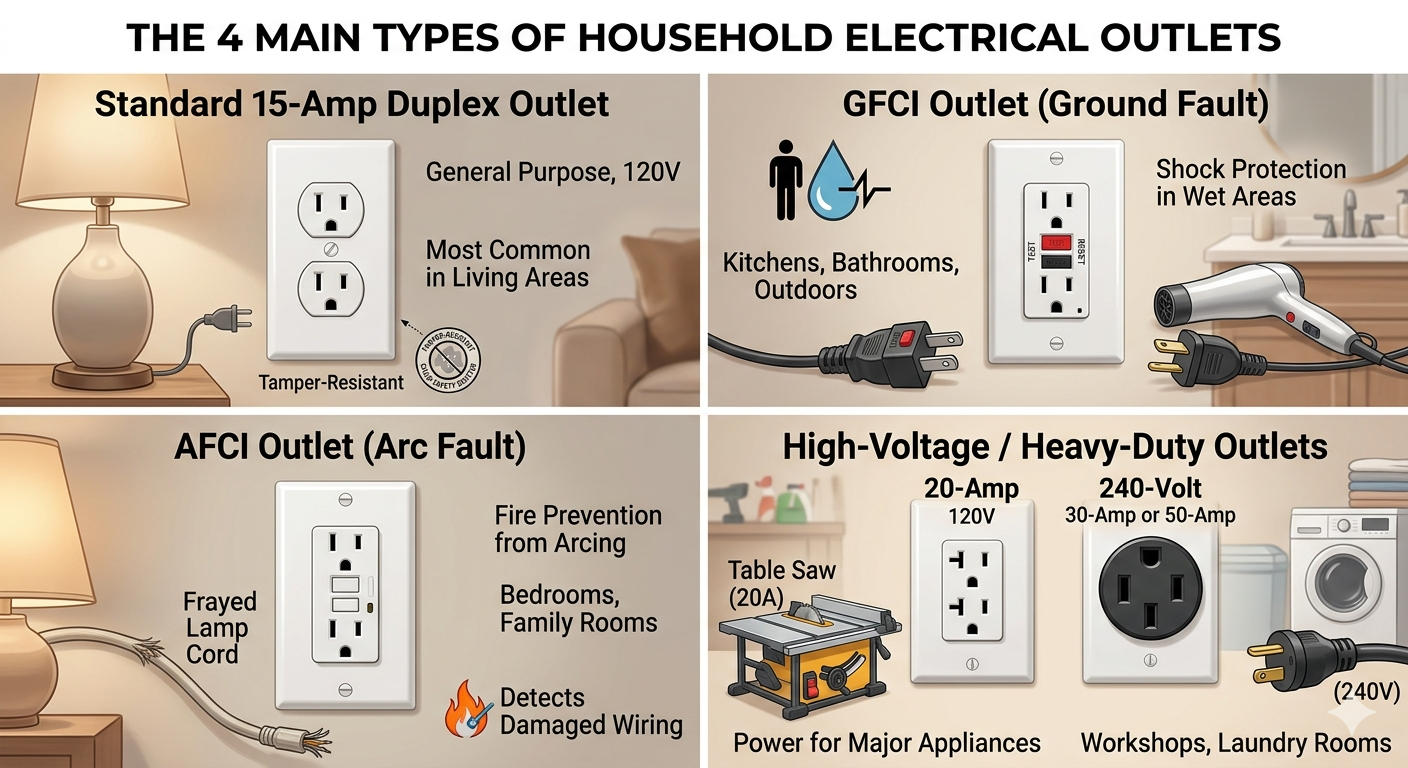
The four primary types of electrical outlets found in modern residential properties are the standard 15-amp duplex outlet, the Ground Fault Circuit Interrupter (GFCI) outlet, the Arc Fault Circuit Interrupter (AFCI) outlet, and high-voltage 20-amp or 240-volt specialty outlets. These components are the essential interface between your home's complex wiring system and your daily appliances, ranging from smartphones to heavy-duty dryers. Understanding these variations is not just a matter of convenience; it is a critical component of electrical fire prevention and personal safety.
Content
- 1. The Standard 15-Amp Duplex Outlet: The Household Workhorse
- 2. GFCI Outlets: Essential Protection for Wet Locations
- 3. AFCI Outlets: The Shield Against Electrical Fires
- 4. High-Voltage and 20-Amp Specialty Outlets
- Comparative Analysis of Outlet Types
- The Importance of Tamper-Resistant (TR) Design
- When to Upgrade Your Home’s Outlets
- Frequently Asked Questions (FAQ)
- Conclusion: Investing in Electrical Integrity
1. The Standard 15-Amp Duplex Outlet: The Household Workhorse
Standard 15-amp duplex outlets are the most ubiquitous power sources in North American homes, designed for general-purpose use with low-wattage electronics. These outlets typically feature two vertical slots and a U-shaped grounding hole, representing the evolution from older, ungrounded two-prong designs. In a typical 1,500-square-foot home, you might find between 40 and 60 of these outlets distributed across bedrooms, living areas, and hallways.
The primary function of these outlets is to provide a consistent 120-volt supply. While they are reliable, they lack the sophisticated internal logic found in safety-oriented models. Modern building codes now require these standard outlets to be Tamper-Resistant (TR). TR outlets feature internal shutters that prevent children from inserting foreign objects like hairpins or keys, a safety feature that has reduced pediatric electrical injuries by nearly 95% since its mandatory adoption in the National Electrical Code (NEC).
2. GFCI Outlets: Essential Protection for Wet Locations
Ground Fault Circuit Interrupter (GFCI) outlets are specialized safety devices designed to prevent lethal electric shocks by instantly cutting power when a ground fault is detected. Identifiable by their "Test" and "Reset" buttons, GFCI outlets are mandatory in areas where water and electricity are likely to meet, such as bathrooms, kitchens, laundry rooms, and outdoor spaces.
The technology behind a GFCI is incredibly precise. It constantly monitors the balance of electrical current moving through the circuit. If the current flowing out of the hot wire differs from the current returning through the neutral wire by as little as 4 to 6 milliamperes, the device assumes the electricity is leaking to the ground (possibly through a human body) and trips within 1/30th of a second. This rapid response is the difference between a minor tingle and a fatal cardiac event.
3. AFCI Outlets: The Shield Against Electrical Fires
Arc Fault Circuit Interrupter (AFCI) outlets are advanced electronic components engineered to detect dangerous electrical arcs and disconnect power to prevent structural fires. While GFCIs protect humans from shock, AFCIs protect the structure from heat-related hazards caused by damaged wiring, loose connections, or pierced cables behind walls.
Electrical arcing occurs when electricity jumps across an unintended gap, creating intense heat—often exceeding 10,000 degrees Fahrenheit—which can easily ignite surrounding insulation or wood framing. The Consumer Product Safety Commission (CPSC) estimates that AFCI technology could prevent more than 50% of electrical fires that occur in homes each year. These outlets use digital signal processing to distinguish between a "normal" arc (like the spark when you turn on a light switch) and an "unwanted" dangerous arc caused by a frayed cord.
4. High-Voltage and 20-Amp Specialty Outlets
High-voltage 240-volt and 20-amp outlets are dedicated power points designed for energy-intensive appliances that would overload a standard circuit. You can distinguish a 20-amp outlet by the small horizontal "T" slot on the neutral side, while 240-volt outlets are much larger and feature unique prong configurations (often circular or with three large angled blades).
These outlets are not interchangeable with standard electronics. A 20-amp outlet is typically found in kitchens or workshops to handle power tools and heavy-duty blenders. On the other hand, 240-volt outlets are reserved for major appliances like electric dryers, ranges, and central air conditioning units. Because these appliances pull a significant amount of current—often between 30 to 50 amps—they require thicker gauge wiring (typically 10-gauge or 8-gauge) to handle the load without overheating.
Comparative Analysis of Outlet Types
To better understand which outlet is required for specific scenarios, the following table compares the primary characteristics and typical applications of the four outlet types discussed.
| Outlet Type | Voltage/Amperage | Primary Benefit | Common Locations |
|---|---|---|---|
| Standard Duplex | 120V / 15A | General Utility | Bedrooms, Living Rooms |
| GFCI | 120V / 15A-20A | Shock Prevention | Kitchens, Bathrooms, Outdoors |
| AFCI | 120V / 15A-20A | Fire Prevention | Sleeping Areas, Family Rooms |
| High-Voltage/20A | 120V-240V / 20A-50A | Heavy Load Capacity | Laundry, Kitchen, Workshop |
Comparison of the 4 types of electrical outlets based on voltage, safety features, and placement.
The Importance of Tamper-Resistant (TR) Design
Tamper-resistant technology is a non-negotiable safety feature in modern outlets, significantly reducing the risk of childhood electrocution. These outlets look identical to standard outlets but contain spring-loaded shutter plates.
The shutters only open when equal pressure is applied simultaneously to both slots—which happens when a standard plug is inserted. If a child attempts to insert a single object, such as a paperclip, the shutters remain closed. According to data from the National Fire Protection Association (NFPA), approximately 2,400 children suffer from severe shocks and burns each year due to inserting objects into outlets. The widespread transition to TR outlets is the most effective solution to this preventable danger.
When to Upgrade Your Home’s Outlets
Homeowners should consider upgrading their outlets if they encounter flickering lights, discolored faceplates, or if the home was built before the mid-1970s and still uses two-prong ungrounded outlets. Modern appliances and electronics require stable grounding to protect sensitive internal circuitry.
- Discoloration: Yellowing or char marks on an outlet indicate internal overheating and are a significant fire risk.
- Loose Plugs: If cords fall out of the outlet easily, the internal contacts are worn out, which can cause arcing.
- Ungrounded Outlets: Replacing two-prong outlets with GFCIs (labeled "No Equipment Ground") or rewiring for a full ground is essential for modern laptop and TV safety.
Frequently Asked Questions (FAQ)
Can I use a 15-amp device in a 20-amp outlet?
Yes, it is perfectly safe to plug a standard 15-amp device into a 20-amp outlet because the device will only "pull" the amount of electricity it needs. The 20-amp rating refers to the capacity of the outlet, not the amount of current it forces into a device.
What is the difference between GFCI and AFCI?
The fundamental difference is that GFCI protects people from shock, whereas AFCI protects the house from fire. GFCIs detect current leaks to the ground, while AFCIs detect dangerous electrical sparking (arcs).
How often should I test my GFCI outlets?
Electrical safety experts recommend testing GFCI outlets once a month by pressing the "Test" button. If the "Reset" button doesn't pop out, the internal safety mechanism has failed, and the outlet should be replaced immediately.
Why do some outlets have a green light?
A green light on a GFCI or AFCI outlet typically indicates that the device is powered and the self-test feature has passed successfully. If the light turns red or goes out, it signals a trip or a device failure.
Conclusion: Investing in Electrical Integrity
Understanding the 4 types of electrical outlets is the first step toward maintaining a safe and efficient modern home. Whether it is the shock-prevention of a GFCI, the fire-prevention of an AFCI, or the heavy-duty power of a 240-volt outlet, each serves a specific and vital role. By ensuring your home is equipped with the correct hardware for the correct location, you not only comply with safety codes but also provide a secure environment for your family and your expensive electronics.
Always remember that while changing an outlet faceplate is a simple DIY task, modifying actual wiring or installing new circuits should always be performed by a licensed electrician to ensure all local building codes and safety standards are met.